
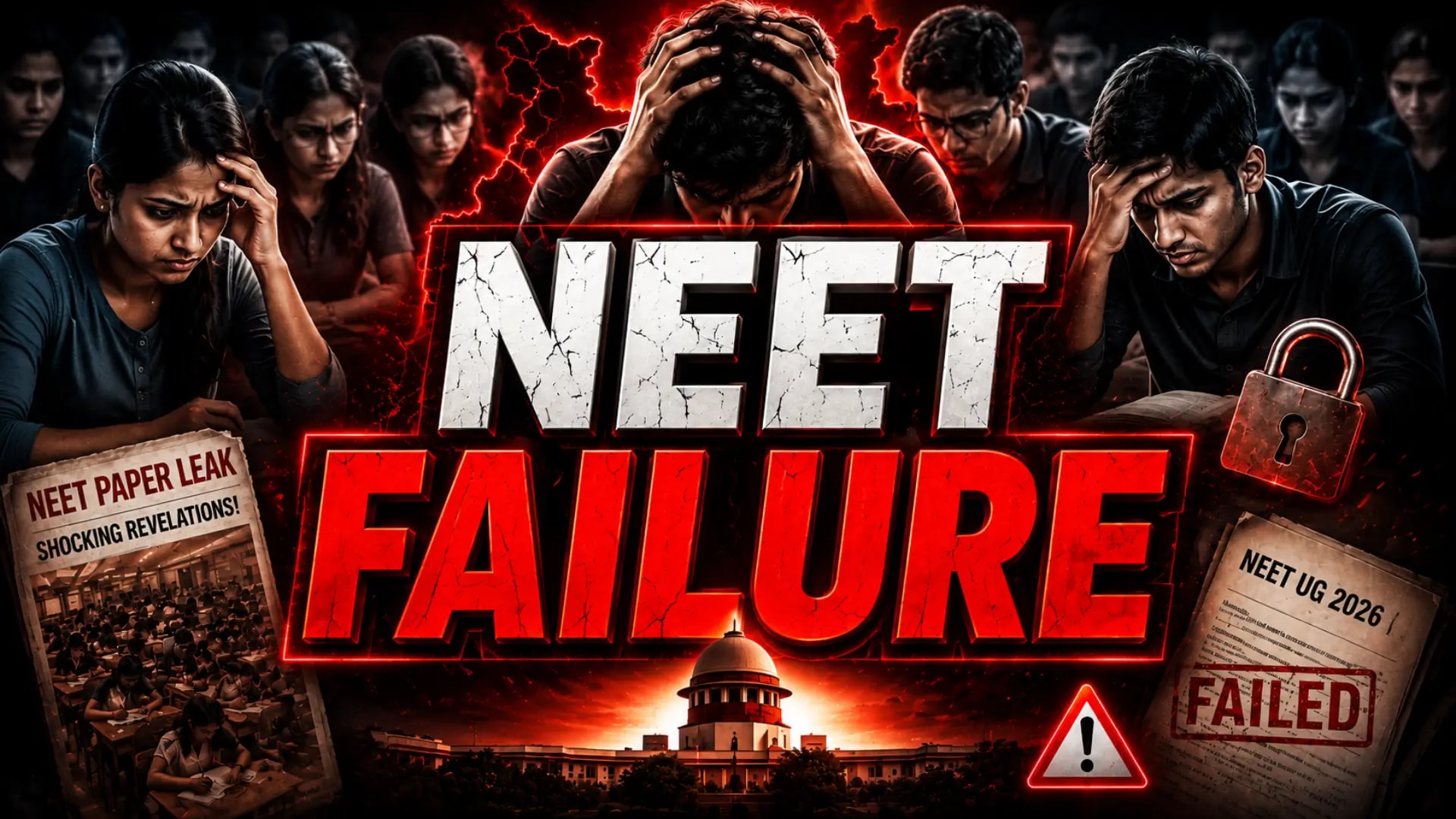
Every year, millions of students across India prepare for one of the country's toughest competitive exams: NEET (National Eligibility cum Entrance Test). For many, it represents years of sacrifice, sleepless nights, financial struggles, and the dream of becoming a doctor.
But what happens when students begin to question whether the examination itself is fair?
The controversy surrounding the alleged NEET paper leak sparked nationwide debates—not just about an exam, but about the credibility of one of India's most important education systems.
More Than Just a Paper Leak
A paper leak is not simply about questions appearing before an exam.
It breaks something much more valuable: trust.
Students spend months—and often years—preparing with discipline. Parents invest their savings in coaching, books, and hostel fees. Teachers dedicate countless hours to mentoring aspirants.
When allegations of leaked papers emerge, every honest student is left wondering:
"Was my hard work enough, or was someone already ahead before the exam even began?"
That question alone can have a lasting impact.
The Pressure on Students
Preparing for NEET is already mentally demanding.
Many students study 10–14 hours a day. They often limit social interactions, hobbies, and family time to focus entirely on one goal.
The uncertainty caused by controversies adds another layer of emotional pressure:
- Anxiety about fairness.
- Fear that merit may not be enough.
- Stress over possible re-examinations.
- Loss of confidence in the system.
For many students, these emotions become harder to handle than the exam itself.
Why Fairness Matters
Competitive examinations are built on one simple principle:
Every candidate should have an equal opportunity.
If that principle is questioned, the consequences extend far beyond a single exam.
It affects:
- Students' confidence.
- Public trust in educational institutions.
- The credibility of selection processes.
- The future of deserving candidates.
An education system functions best when students believe that honesty and hard work are rewarded.
The Role of Authorities
Whenever allegations arise, investigating agencies and examination authorities have the responsibility to examine the evidence thoroughly and take appropriate action.
Transparency becomes essential.
Students deserve timely communication, clear explanations, and decisions that prioritize fairness over uncertainty.
Whether allegations are confirmed or disproved, trust can only be rebuilt through openness and accountability.
Beyond Blame
The conversation should not stop at identifying who is responsible.
It should also focus on prevention.
Possible improvements include:
- Stronger digital security.
- Better monitoring of examination processes.
- Faster investigation mechanisms.
- Strict action against organized cheating networks.
- Improved transparency during evaluations.
The goal is not simply to react after a controversy but to reduce the chances of future incidents.
The Human Side
Behind every roll number is a person.
Someone who woke up before sunrise to study.
Someone who gave up festivals, vacations, and celebrations.
Someone whose family placed their hopes on a single opportunity.
When examination systems fail, the impact is measured not only in headlines but also in thousands of individual dreams.
A Lesson for the Future
The NEET paper leak debate is about more than one examination.
It reminds us that educational systems must continuously evolve to remain fair, transparent, and trustworthy.
Students should compete with each other's knowledge—not with corruption, uncertainty, or privilege.
Because in the end, the true value of an examination is not the score it produces.
It is the confidence every student has that the result was earned honestly.
What do you think?
Should India adopt stronger technological safeguards and more transparent examination systems to protect the integrity of competitive exams?
Share your thoughts below. Every perspective adds to the conversation.




Comments (0)
No comments yet. Be the first to comment!