
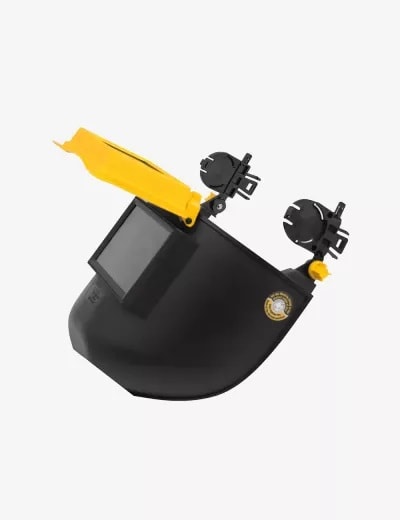

In industrial environments where hazards can reach the face from multiple directions simultaneously, face shields provide a level of protection that spectacles and goggles alone cannot match. A safety spectacle protects the eye. A face shield protects the entire face, including the forehead, cheeks, and chin, from impact, liquid splash, and in the case of welding shields, the intense radiation produced by arc and gas processes. Understanding when a face shield is the appropriate choice, and which type of shield addresses which hazard, is the starting point for any correct specification decision.
When a Face Shield Is the Right Choice
Face protection becomes necessary whenever the hazard profile includes risks that extend beyond what eye protection alone can cover. Grinding and cutting operations generate debris that can approach the face from below or at angles that spectacles do not protect. Chemical splash during mixing, transfer, or cleaning operations can reach the face and neck area. Welding produces visible light, infrared radiation, and ultraviolet radiation simultaneously at intensities that cause both immediate and cumulative damage to unprotected eyes and skin. In each of these cases, a shield that covers the full face is the appropriate primary protective measure, often used in combination with underlying safety spectacles or goggles.
Types of Face Shields and Their Applications
Face shields are broadly divided into two design families: standalone headgear-mounted shields and helmet-mountable shields. Each serves a different operational profile.
Standalone Face Shields: A standalone face shield consists of a clear polycarbonate visor mounted on a dedicated headgear assembly with its own sizing and adjustment mechanism. Ratchet-type headgear allows quick size adjustment and a secure fit across different head circumferences. The polycarbonate visor provides high impact resistance, optical clarity, and protection against chemical splash.
Helmet-Mountable Face Shields: Helmet-mountable shields attach to the brim of a safety helmet and flip up when not required, giving the worker the flexibility to alternate between face-protected and face-uncovered working positions without removing or repositioning equipment. This design is practical in environments where workers move between tasks requiring face protection and tasks requiring better peripheral vision or communication.
Integrated Welding Helmet: An integrated welding helmet combines head and face protection in a single unit, providing complete coverage without the need for a separate safety helmet. This design suits dedicated welding operations where the worker remains primarily at a fixed workstation and does not need to alternate between welding and non-welding tasks involving different head protection requirements.
Wearing Face Shields Correctly
Even a correctly specified face shield provides inadequate protection if worn incorrectly. The visor must cover the full face including the chin and forehead. Any gap between the headgear and the top of the shield reduces protection from above, and any gap at the chin introduces the possibility of splash or debris reaching the face from below. For helmet-mountable shields, the attachment mechanism must be securely engaged before work begins. A shield in the flipped-up position provides no protection.
Conclusion
The correct face shield for welding is the product that matches the specific radiation hazard of the process being performed, provides the appropriate filter shade for the current and electrode specification in use, carries EN 175 and EN 169 certification, and integrates reliably with the rest of the worker's PPE. Beyond welding, the broader face shield category provides critical protection across grinding, chemical, and mechanical impact environments.




Comments (0)
No comments yet. Be the first to comment!