
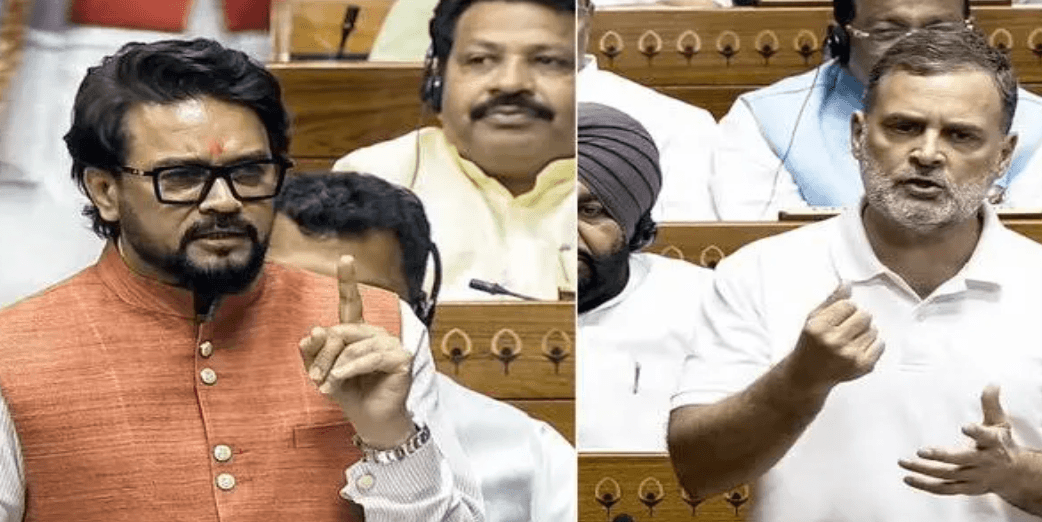

Parliament witnessed another political flashpoint after Anurag Thakur moved a privilege notice against Rahul Gandhi, accusing the Congress leader of making misleading statements during parliamentary proceedings. The development has sparked fresh debate over parliamentary privilege, accountability, and the increasingly confrontational nature of Indian politics.
If you have been following the headlines but are unsure what actually happened, here's a simple breakdown of the controversy.
Why Did Anurag Thakur Move a Privilege Notice?
The controversy began after Rahul Gandhi made remarks during a debate in Parliament that the BJP claimed were factually incorrect and misleading. Responding strongly, senior BJP leader and Member of Parliament Anurag Thakur submitted a privilege notice against Rahul Gandhi.
According to Thakur, the statements made by Rahul Gandhi were not supported by facts and had the potential to mislead Parliament and the public. The BJP argued that members of Parliament are expected to present accurate information while speaking in the House.
The privilege notice seeks action under the rules governing parliamentary conduct if it is found that the statements violated parliamentary privileges.
What Is a Privilege Notice?
A privilege notice is a formal complaint submitted by a Member of Parliament when they believe that another member has breached the privileges of the House or misled Parliament.
Parliamentary privilege exists to protect the dignity and functioning of Parliament. If the Speaker or Chairman accepts a privilege notice, it may be referred to the Privileges Committee for examination.
However, not every privilege notice is admitted. The presiding officer first decides whether the matter deserves further consideration.
Rahul Gandhi's Remarks at the Centre of the Dispute
Rahul Gandhi's speech reportedly included allegations and criticism directed at the central government. BJP leaders alleged that some of these claims lacked factual backing.
Anurag Thakur argued that making incorrect statements inside Parliament undermines democratic institutions and parliamentary proceedings. Congress leaders, on the other hand, defended Rahul Gandhi, stating that he was exercising his democratic right to question the government.
The disagreement has once again highlighted the sharp political divide between the ruling BJP and the opposition Congress.
What Happens Next?
The fate of the privilege notice depends on whether the Speaker decides to admit it.
Possible outcomes include:
- The notice may be rejected.
- It may be admitted and referred to the Privileges Committee.
- The committee could examine the matter and recommend further action if required.
The process can take time, and there is no guarantee that disciplinary action will follow.
Political Significance
The Anurag Thakur privilege notice against Rahul Gandhi comes at a time when Parliament has witnessed repeated confrontations between the government and the opposition over several national issues.
Such notices often become part of larger political battles, with both sides using parliamentary procedures to strengthen their arguments before the public. While legal and procedural aspects remain important, the political messaging surrounding these developments is equally significant.
For the BJP, the notice reinforces its claim that opposition leaders should be held accountable for statements made inside Parliament. For Congress, the issue is likely to be presented as an attempt to suppress criticism of the government.
Conclusion
The Anurag Thakur Privilege Notice Against Rahul Gandhi has become one of the latest controversies inside Parliament. Whether the notice progresses further will depend on the Speaker's decision and the parliamentary process. Regardless of the outcome, the episode reflects the increasingly heated exchanges that continue to shape India's parliamentary politics.


Comments (0)
No comments yet. Be the first to comment!