
The Art of the Unseen Side
In Srinagar’s traditional hand-embroidery workshops, Sozankars create beautiful Sozni embroidery which is a Geographical Indication (GI No. 48) and has been practised for over 200 years. Using a slender steel needle, they embroider elaborate designs of flowers, vines and chinar and paisley on to a plain weave Pashmina fabric. This can take between two and six months.
Generally, the reverse of mass-produced embroidered items is of little concern and tends to be a disorganised jumble of threads and inflexible backing material.
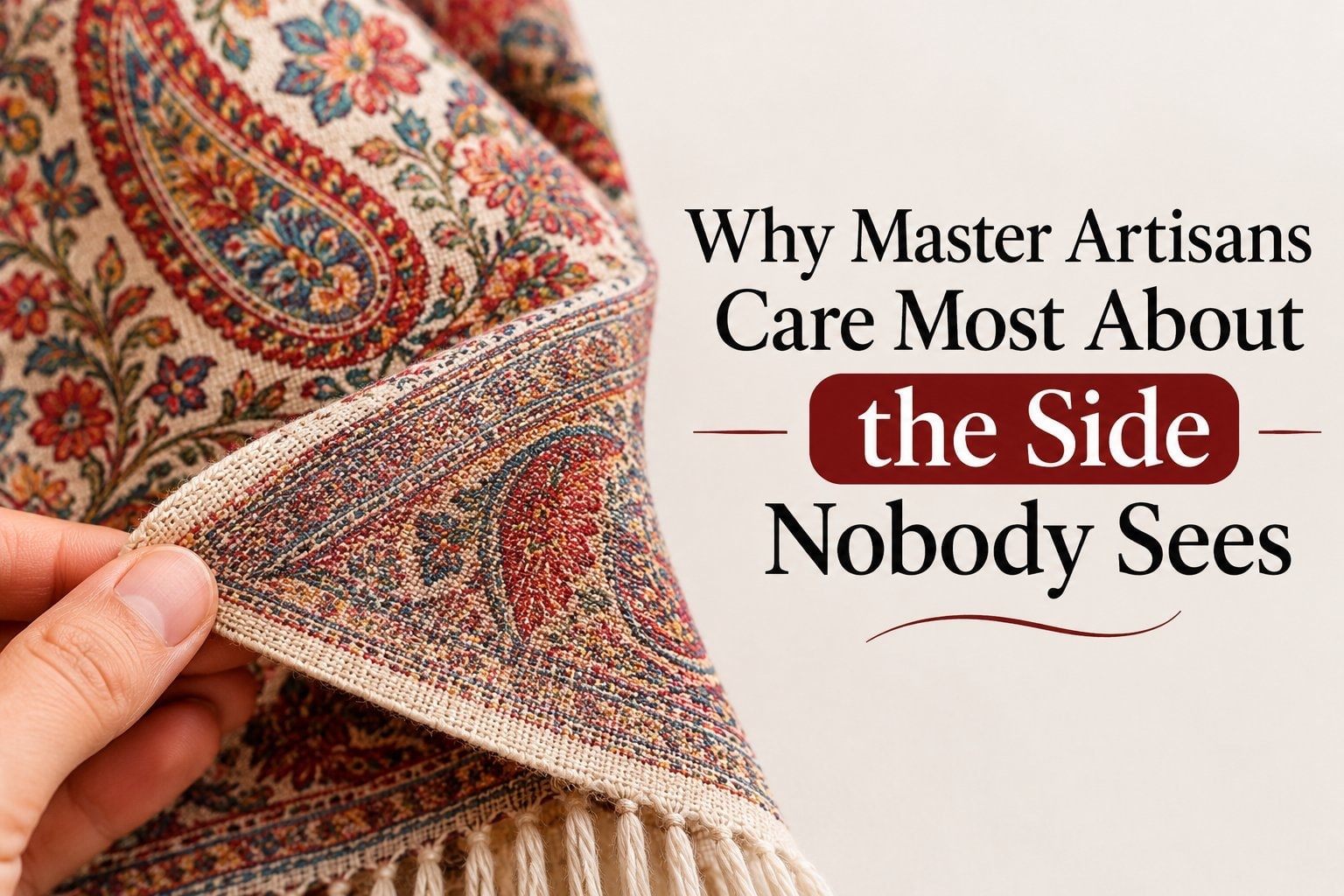
However, at an expert level, Sozni embroidery is just as meticulously finished on the reverse as the front. Precise couching and careful handling of thread tension is used to produce a reverse image, almost identical to that of the front – with barely any knots and crossings. Furthermore, the shawl can be worn over either shoulder and there is no ‘false’ side to the fabric.
Similarly, Kani weaving (GI No. 51) is also subtly and consistently executed. Coloured Pashmina threads are woven together in rows by weavers who use small wooden spools (kanis) and a secret abbreviated writing system (talim) to direct their weaving. For between six months and two years, each colour change is accurately and permanently incorporated into the weave, on a wooden loom. Upon turning the item over, the reverse can be seen to be a serene and well-ordered replica of the front.
What Craft Teaches Us About Character?
We exist within an economy which encourages us to prioritise outward presentation. Where value is added through speed and visual appeal, it can become acceptable to compromise ‘behind the scenes’ in the name of efficiency.
However, compromise is always exposed. Poorly tied sections become loose and then come undone. Rushed structures lack rigidity.
Spending four months ensuring that an artisan’s binding is perfectly tied (even when folded towards a coat), alters our understanding of quality. Whilst we often associate quality with something performed for others to view, it is in fact about how you manage your work, and your interactions and lifestyle – in the absence of external scrutiny of ‘behind the scenes’.
Choosing Objects with Quiet Honesty
Surrounding ourselves with things made under that standard changes how we move through the day. Whether it is a hand-joined wooden table, a well-bound book, or one of the documented handwoven women's Kashmiri Pashmina shawls and stoles preserved by workshops in Srinagar, objects built with reverse-side honesty carry a stillness that mass-produced substitutes never replicate.
The next time you find yourself rushing through the unseen parts of a task just to get it finished, pause and remember the Sozankar’s needle: how you finish the back is what holds the front together.
Business
Why Master Artisans Care Most About the Side Nobody Sees
In Srinagar’s historic Sozni and Kani workshops, the true measure of a textile isn’t its front—it’s the quiet discipline hidden on the reverse side.

Sofi Basharat
1d ago · 2 min read
Enjoyed this?
Written by
Sofi BasharatMore to Read

Dubai Tax Consultants: Professional Tax Solutions for Businesses
Sanya Bansal · 1 min read

What Two Years on a Wooden Loom Teaches Us About Patience: Inside Srinagar’s Quietest Craft
Sofi Basharat · 3 min read

The Coffee Shop Lesson: Why Small Businesses Win Big
Vikram Joshi · 6 min read

Top 10 Office Wear Outfit Ideas for Working Women
Gunjan DA · 2 min read
Comments (0)
No comments yet. Be the first to comment!