
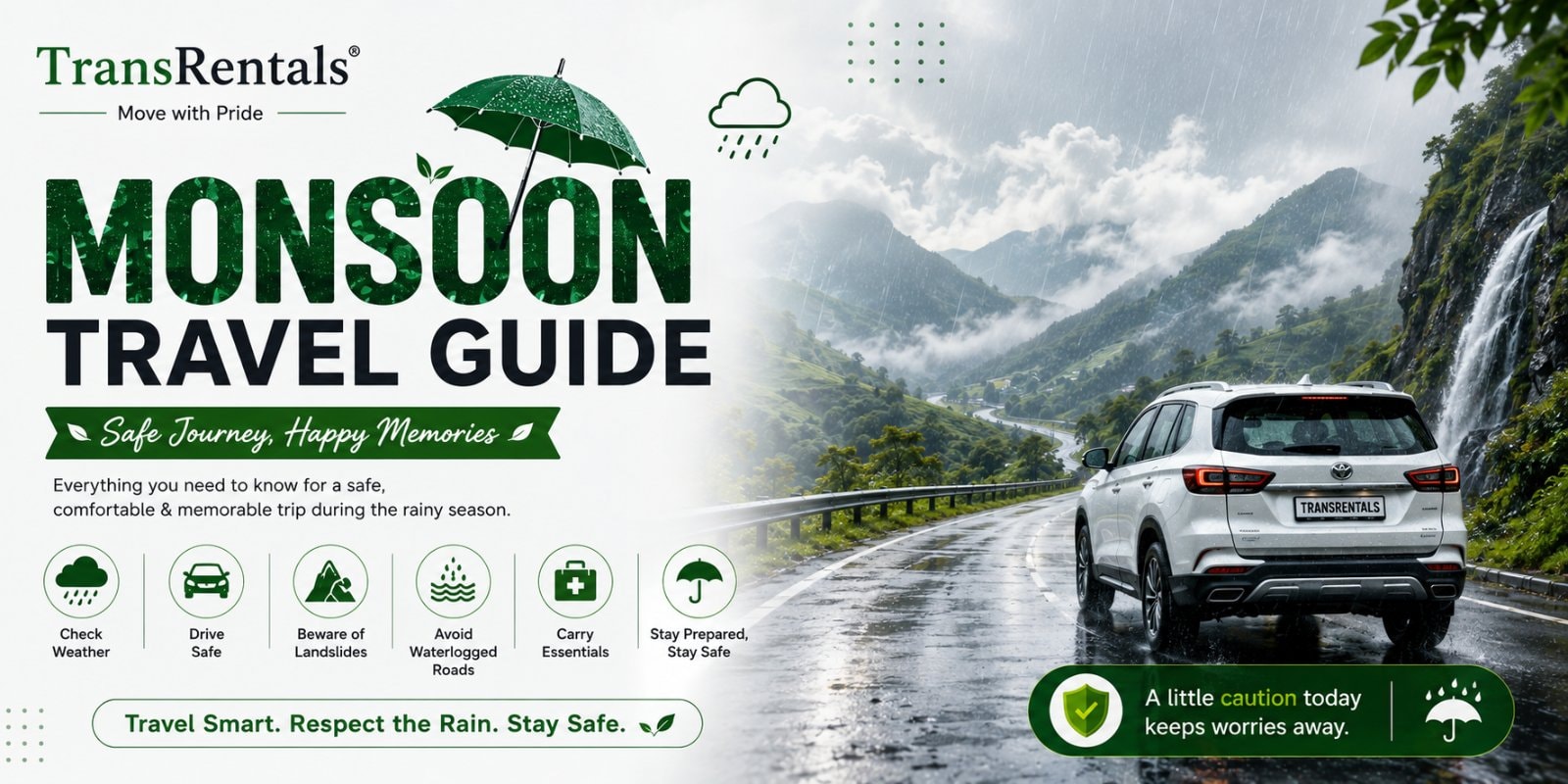

There is something magical about travelling during the rainy season.
The first drops of rain hit the windshield, the mountains slowly disappear behind a layer of mist, waterfalls begin flowing, trees become greener, and the entire landscape seems to come alive.
For many travellers, monsoon is one of the most beautiful times of the year to explore India.
But the rainy season also changes the way we should travel.
A road that was perfectly safe yesterday may become slippery today. A small stream can turn into a fast-flowing river after heavy rainfall. A beautiful mountain road can suddenly be blocked by mud or rocks. Even a simple road trip can become stressful if the vehicle is not properly prepared.
This is why monsoon travel requires a different approach.
The purpose of this guide is not to make you afraid of travelling during the rainy season. Instead, it is to help you understand the risks, prepare properly, and enjoy the journey responsibly.
A Beautiful Monsoon Trip Can Change Quickly
Imagine this.
A family of five decides to take a road trip to a beautiful hill destination. The weather forecast shows light rain, so they start their journey early in the morning.
For the first few hours, everything is perfect.
The roads are wet, the hills are covered with greenery, and everyone is enjoying the scenery.
Then, as they approach the mountains, the rain becomes heavier.
Visibility decreases.
The road becomes slippery.
A few kilometres ahead, traffic suddenly stops.
They discover that a small landslide has blocked one side of the road.
Fortunately, they had planned their journey properly. They had checked the weather, kept an alternative route ready, carried food and water, and allowed extra time for the journey.
Instead of taking a risky shortcut, they wait for reliable information and safely change their route.
This simple example highlights an important lesson:
Good preparation can turn an unexpected problem into a manageable delay.
Why Travel During the Rainy Season?
The monsoon season has a special charm.
Across many parts of India, rainfall transforms ordinary landscapes into beautiful natural destinations.
Travellers can enjoy:
Lush green mountains
Mist-covered valleys
Flowing waterfalls
Fresh forests
Beautiful lakes and rivers
Pleasant temperatures in many regions
Fewer crowds at selected destinations
Unique photography opportunities
Refreshing road-trip experiences
However, beautiful scenery should never make us forget about safety.
The same rain that creates a beautiful waterfall can also make the surrounding rocks extremely slippery.
The same rain that makes a forest green can also create muddy roads.
The same mountain clouds that look beautiful in photographs can reduce visibility for drivers.
Enjoy the beauty, but respect the weather.
1. Check the Weather Before Leaving
Before starting a monsoon journey, check the latest weather conditions for your entire route—not just your final destination.
A common mistake is checking the weather only for the place where you are going.
For example, your destination may have light rain, but the highway or mountain road leading to it could be experiencing heavy rainfall.
Check for:
Heavy rainfall warnings
Thunderstorms
Flood alerts
Landslide warnings
Road closures
Highway conditions
Local weather advisories
If severe weather is expected, consider postponing non-essential travel.
A simple example
Suppose you are planning a Sunday road trip.
The destination forecast says:
Light rain – Safe for sightseeing.
But the route forecast says:
Heavy rainfall – Possible road disruption.
In this situation, the route matters just as much as the destination.
2. Plan Your Journey With Extra Time
Monsoon travel rarely works perfectly according to a fixed schedule.
Rain can slow down traffic, create congestion, cause diversions, and reduce driving speed.
If a normal journey takes five hours, don't plan your schedule assuming you will always arrive in exactly five hours.
Keep some additional time as a buffer.
This becomes especially important when travelling to:
Airports
Railway stations
Hotels
Business meetings
Events
Connecting transportation
Remember:
A flexible itinerary is safer than a rushed itinerary.
3. Choose the Right Vehicle
Your vehicle becomes one of the most important parts of your journey during the rainy season.
Whether you are using your own car or renting a vehicle, make sure it is properly maintained.
Check:
Tyres
Brakes
Windshield wipers
Headlights
Indicators
Horn
Battery
Defogging system
Spare tyre
Basic tools
Vehicle documents
For long-distance or hilly journeys, vehicle condition becomes even more important.
Example
Imagine two travellers planning the same mountain trip.
Traveller A chooses a vehicle simply because it is cheaper.
Traveller B checks the vehicle condition, tyre quality, brakes, wipers, and overall maintenance before starting.
When heavy rain begins, Traveller B has greater confidence because the vehicle was properly checked.
The lesson is simple:
During monsoon travel, reliability should come before price.
4. Drive Slowly on Wet Roads
One of the most common rainy-season mistakes is driving at the same speed as on dry roads.
Wet roads can reduce tyre grip.
Sudden braking, acceleration, or steering can make the vehicle harder to control.
Drive smoothly and reduce speed when:
Rain becomes heavy
Visibility decreases
Roads become slippery
You approach curves
You enter a waterlogged area
You drive through hilly terrain
Avoid aggressive driving and unnecessary overtaking.
5. Maintain a Safe Following Distance
Rain can increase braking distance.
If the vehicle ahead suddenly brakes, you need additional time and space to respond.
Keep more distance than you normally would.
Example
A car is travelling ahead of you on a wet highway.
Suddenly, the driver notices a pothole and brakes.
If you are travelling too close, you may not have enough time to react.
If you have maintained a safe distance, you have more time to slow down safely.
A few extra seconds can make a major difference.
6. Beware of Hydroplaning
Hydroplaning occurs when a layer of water comes between the tyres and the road surface, reducing the tyres' contact with the road.
The steering may suddenly feel lighter and the vehicle may become difficult to control.
To reduce the risk:
Reduce speed during heavy rain
Maintain good tyre condition
Avoid sudden steering
Avoid sudden braking
Maintain adequate distance
If the vehicle begins losing traction, remain calm and avoid sudden movements.
7. Be Extremely Careful With Floodwater
Flooded roads are one of the biggest risks during monsoon travel.
Water can hide:
Deep potholes
Open drains
Broken roads
Debris
Loose surfaces
Strong currents
Never assume that a flooded road is safe simply because another vehicle has crossed it.
A small example
You see a road covered with water.
It appears to be only a few inches deep.
But you cannot see the road surface underneath.
There could be a large pothole or an open drain.
Taking a few minutes to find another route is much safer than risking your vehicle and passengers.
If you cannot judge the depth or condition of the water, don't enter it.
8. Never Challenge Fast-Moving Water
A shallow-looking stream can become extremely powerful after heavy rainfall.
Never attempt to drive, walk, or ride through fast-moving water simply because the destination is close.
Water can move vehicles, motorcycles, and even people.
If authorities have closed a road because of flooding, follow the restriction.
No shortcut is worth risking your life.
9. Take Extra Care on Mountain Roads
Mountain travel during monsoon can be spectacular.
But hills also require additional caution.
Heavy rainfall can cause:
Landslides
Rockfalls
Mudslides
Road damage
Falling trees
Poor visibility
Sudden water flow
Avoid stopping unnecessarily near unstable slopes.
If you see signs of falling rocks, fresh mud, cracks, or damaged roads, move away from the area when it is safe to do so.
Always follow local road advisories.
10. Watch for Landslides
Landslides can occur after heavy rainfall, particularly in hilly and mountainous regions.
Imagine this situation:
You are travelling through a beautiful mountain road when traffic suddenly stops.
A few hundred metres ahead, mud and rocks have fallen onto the road.
Some travellers may be tempted to get out and walk closer to take photographs.
This is dangerous.
There may be additional unstable rocks above the road.
The safer decision is to remain at a safe distance and follow instructions from local authorities or road workers.
Never treat a landslide area as a sightseeing spot.
11. Be Careful With Potholes
Rainwater can hide potholes.
A vehicle travelling quickly through a water-filled pothole can suffer damage to:
Tyres
Wheels
Suspension
Steering components
Slow down when approaching large puddles, particularly when you cannot see the road underneath.
12. Use Headlights & Wipers Properly
Heavy rain can reduce visibility for both drivers and pedestrians.
Make sure:
Wipers work properly
Windshield is clean
Headlights are functioning
Mirrors are clean
Defogging system works
Use appropriate headlights when visibility is reduced.
Avoid using high beams unnecessarily because they can create glare for other drivers.
13. Avoid Distracted Driving
Rainy conditions already demand additional concentration.
Using a mobile phone while driving can make the situation even more dangerous.
Avoid:
Texting
Taking photographs
Watching videos
Adjusting navigation while moving
Eating while driving
Handling unnecessary objects
If you need to use your phone, stop somewhere safe.
One message can wait.
One photograph can wait.
Safety cannot.
14. Take Regular Breaks
Long-distance driving during rain can be tiring.
Poor visibility, traffic congestion, and continuous concentration can increase driver fatigue.
Take regular breaks.
Stop at a safe location to:
Rest
Stretch
Drink water
Eat
Check the vehicle
If the driver feels sleepy, do not continue simply because the destination is close.
15. Watch for Falling Trees & Branches
Heavy rain and strong winds can weaken trees and branches.
Avoid parking under large trees during severe weather.
If you see a tree that appears unstable, maintain a safe distance.
This is particularly important when stopping for photographs or roadside breaks.
16. Be Careful Around Waterfalls
Waterfalls are among the most attractive monsoon destinations.
However, they can also become dangerous.
Water flow may increase rapidly after rainfall, and rocks around waterfalls can become extremely slippery.
Avoid:
Climbing wet rocks
Entering restricted areas
Standing close to the edge
Swimming in unknown water
Crossing safety barriers
Beautiful scenery is not worth a dangerous photograph.
Stay in designated viewing areas and follow local instructions.
17. Avoid Risky River & Trekking Activities
Monsoon can change the condition of trekking trails, rivers, and streams very quickly.
A trail that was safe yesterday may become slippery or unstable after heavy rain.
Before participating in an outdoor activity, check local conditions and follow professional or official guidance.
Do not enter restricted areas.
18. Protect Yourself From Slips & Falls
Wet surfaces can become extremely slippery.
This is common around:
Waterfalls
Viewpoints
Trekking routes
Bridges
Hotel entrances
Parking areas
Rocks
Staircases
Wear suitable footwear with good grip.
Walk slowly and avoid running on wet surfaces.
19. Protect Your Electronics & Documents
Rain can quickly damage electronic equipment.
Protect:
Mobile phones
Cameras
Laptops
Chargers
Passports
Identification documents
Tickets
Booking confirmations
Use waterproof pouches or sealed bags.
Keeping digital copies of important documents can also be useful.
20. Carry the Right Monsoon Clothing
A good monsoon travel bag should include practical clothing.
Consider carrying:
Raincoat
Umbrella
Waterproof footwear
Extra socks
Quick-drying clothes
Light jacket
Small towel
Keep at least one complete change of clothes easily accessible.
Getting wet is part of monsoon travel—but staying wet for hours does not have to be.
21. Carry a Monsoon Emergency Kit
A small emergency kit can be extremely useful.
Consider carrying:
First-aid supplies
Drinking water
Power bank
Phone charger
Flashlight
Waterproof bags
Basic vehicle tools
Spare tyre equipment
Personal medicines
Extra food
Emergency contact information
For remote journeys, additional supplies may be appropriate.
22. Be Prepared for Vehicle Breakdowns
Even a well-maintained vehicle can experience unexpected problems.
Possible issues include:
Tyre puncture
Battery failure
Electrical problems
Brake issues
Wiper failure
Mechanical problems
If your vehicle breaks down:
Move to a safe location if possible.
Turn on hazard lights.
Keep passengers away from traffic.
Contact roadside assistance or the rental provider.
Avoid standing in flooded areas.
Wait for professional assistance.
Do not attempt complicated repairs in unsafe weather conditions.
23. Be Prepared for Traffic & Route Diversions
Rain can cause unexpected traffic delays.
Roads may be blocked because of:
Flooding
Accidents
Fallen trees
Landslides
Road repairs
Waterlogging
Navigation applications may not immediately reflect every local road closure.
Therefore, follow local signs and official instructions instead of blindly following a navigation route.
24. Keep Your Phone Charged
Your phone can become an important safety tool during travel.
Before starting:
Fully charge your phone
Carry a power bank
Save emergency contacts
Download offline maps
Save hotel details
Keep booking information accessible
In remote locations, network connectivity may not always be available.
25. Share Your Travel Plan
If you are travelling alone or visiting remote locations, tell someone you trust about your journey.
Share:
Destination
Route
Accommodation
Approximate arrival time
Vehicle details where appropriate
If your plans change significantly, update them when practical.
26. Be Careful With Food & Drinking Water
During the rainy season, travellers should pay additional attention to food and water hygiene.
Drink safe water and choose hygienic food establishments.
Avoid food that has been exposed to rainwater, dirt, or poor storage conditions.
Carry drinking water during long road journeys.
27. Respect Local Warnings
Local authorities often have the most relevant information about road and weather conditions.
If officials advise travellers to avoid a route, follow the warning.
Do not cross:
Barricades
Closed roads
Restricted trekking routes
Flooded roads
Unsafe bridges
A travel plan can always be changed.
Your safety cannot.
28. Don't Let Social Media Influence Risky Decisions
Monsoon destinations often become popular on social media.
You may see beautiful photographs of people standing near waterfalls, cliffs, rivers, or mountain roads.
Remember that a photograph does not show the entire situation.
The location may have:
Changed weather
Increased water flow
New restrictions
Slippery surfaces
Dangerous conditions
Never copy a risky activity simply because it looks safe in a photograph.
Common Monsoon Travel Mishaps
Understanding common problems can help you avoid them.
Vehicle Skidding
Usually associated with wet roads, speed, sudden braking, or poor tyre condition.
Hydroplaning
Occurs when tyres lose proper contact with the road because of standing water.
Flooding
Can make roads impassable and hide dangerous obstacles.
Landslides
Can block mountain roads and create additional hazards.
Pothole Damage
Water can hide potholes and cause tyre or suspension damage.
Reduced Visibility
Heavy rain, fog, and spray can make it difficult to see other vehicles.
Vehicle Breakdown
Mechanical or electrical problems can become more difficult to handle during heavy rain.
Slips & Falls
Wet rocks, stairs, roads, and trekking trails can become extremely slippery.
Falling Trees
Strong winds and saturated soil can increase the risk of falling branches or trees.
Waterfall Accidents
Strong water flow and slippery rocks can create serious hazards.
Traffic Delays
Flooding, accidents, road closures, and landslides can significantly increase travel time.
Loss of Connectivity
Remote areas may have limited mobile network and electricity.
What Should You Do If Something Goes Wrong?
If you face an unexpected situation during your journey, don't panic.
Follow these basic principles:
Stay calm.
Move away from immediate danger.
Keep passengers safe.
Contact the appropriate assistance or emergency service.
Inform someone you trust.
Follow local authority instructions.
Do not take additional risks to continue your journey.
The priority should always be people first, vehicle second, itinerary last.
Monsoon Travel Checklist
Before leaving for your journey, make sure you have considered:
Weather forecast
Route condition
Alternative route
Vehicle condition
Tyres
Brakes
Wipers
Headlights
Emergency kit
Raincoat
Umbrella
Extra clothes
Waterproof bags
Drinking water
Phone charger
Power bank
Offline maps
Important documents
Emergency contacts
Accommodation details
Extra travel time
A Final Monsoon Travel Story
Let's imagine one final journey.
A group of friends plans a weekend road trip to the hills.
They are excited.
They pack their bags, choose a comfortable rental vehicle, and leave early in the morning.
Halfway through the journey, heavy rain begins.
Instead of increasing speed to reach the destination quickly, the driver slows down.
They maintain a safe distance.
A little later, they encounter waterlogging.
They stop at a safe location and check the road condition instead of blindly driving through the water.
Further ahead, they discover that a mountain road has been temporarily closed because of a landslide.
Their original itinerary is no longer possible.
At first, everyone is disappointed.
But they have enough time because they planned a flexible schedule.
They find an alternative route, reach their accommodation safely, and spend the evening enjoying the rain from a safe location.
The next morning, the weather improves.
They continue their journey and enjoy the mountains without taking unnecessary risks.
Years later, they remember that trip—not because everything went exactly according to plan, but because they handled the unexpected situations responsibly.
That is what responsible travel is about.
A good traveller does not simply ask:
“How quickly can I reach my destination?”
A responsible traveller asks:
“How can I reach my destination safely?”
Final Thoughts: Travel Smart During the Rainy Season
The rainy season can create some of the most beautiful travel experiences.
But beautiful destinations should be explored with awareness and respect for nature.
Check the weather.
Plan your route.
Choose a reliable vehicle.
Drive carefully.
Maintain a safe distance.
Never take chances with floodwater.
Be cautious on mountain roads.
Respect road closures.
Protect your belongings.
Carry emergency supplies.
And always listen to local safety warnings.
Most importantly, remember:
Travel Smart. Respect the Rain. Stay Alert. Stay Safe.
Because the best travel story is not the one where nothing unexpected happens.
It is the one where, even when something unexpected happens, you are prepared enough to handle it safely.




Comments (0)
No comments yet. Be the first to comment!